
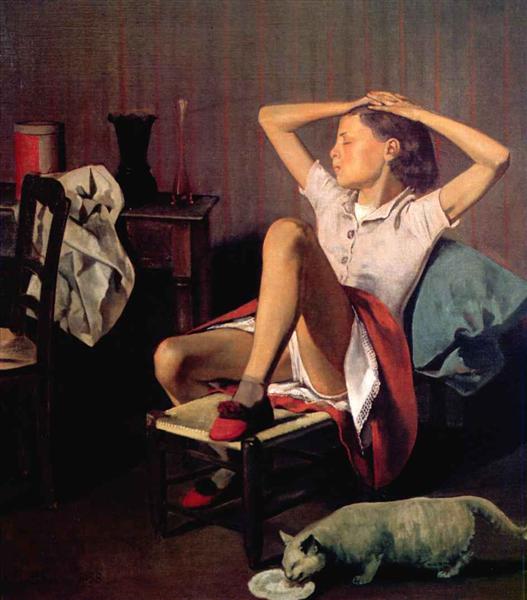
Dreaming Teresa is a perverse painting, and therefore controversial, and therefore outrageous … Balthus painted it in 1938, so before World War II, so basically beyond the area of our interest in Eyeopener. And yet, thanks to the #Metoo campaign, it has become modern again, it has come back.
The painting shows the artist’s Parisian neighbor, Thérèse Blanchard, who was probably only 13 years old when the canvas was painted. In the wake of the #metoo protests, women in New York demanded that the painting be removed from the Metropolitan Museum’s wall, but the management resisted the demands and the painting can still be seen. However, he poses a question, what to do with perverse art? And does it make sense to remove perversion from the space of art … Or maybe only this perversion is inconvenient. which is ideologically wrong?
Balthus has Polish-Jewish roots. However, he grew up in France, with which he is associated.

In meditation on this painting, wrote in The New York Times:
A few days ago, two sisters, Anna Zuccaro, 26, and Mia Merrill, 30, sent an online petition to the Metropolitan Museum of Art, asking for the removal or at least re-interpretation of the painting Thérèse Dreaming, depicting a young woman in a sleepy, erotic lying position. To paint the canvas, the artist Balthasar Klossowski de Rola, or Balthus, used the model Thérèse Blanchard, the daughter of the owner of a neighboring Parisian restaurant, and he did it continuously over the course of three years, making 10 paintings depicting a girl from the moment she was 11 years old. The painting in question shows her at the age of 12 or 13, legs bent and slightly apart, eyes closed and thoughts seemingly lost in fantasies. Her skirt is pulled up to reveal white cotton underwear.
Writing about the Balthus exhibition at the Met four years ago, art critic Peter Schjeldahl noted: “Looking at the paintings, I was still thinking about Oscar Wilde’s verse: A bad man is one who admires innocence.”
The seemingly petition, which quickly gained over 10,000 signatures, appears to be a parody. But … “when I went to the Metropolitan Museum of Art last weekend,” Merrill states, “I was shocked to see a painting of a young girl in a sexually suggestive pose.” This is an apparently unlikely reaction to an art history student at New York University who is involved in feminist affairs. But it is followed by a perfectly reasonable demand, not censorship, not removal or destruction, but an attempt to keep the young from getting embarrassed. The petitioners want to provide the right context, for example in the form of an expanded text around a piece of art that is rooted in something we are trying to protect young people from: the sexualized abuse of power.

[eltdf_section_title position=”center” title_tag=”h1″ disable_break_words=”no” text_tag=”p” text_font_weight=”” caption=”te obiekty są warte uwagi” caption_color=”#c9ab81″ title=”Inspirowane Codziennikami” text=”Poniżej prezentowane dzieła sztuki możesz kupić od ręki za pośrednictwem ToTuart” text_font_size=”19px” text_line_height=”28px” text_margin=”20px 0 0 0″ caption_margin=”0 0 4px 0″][vc_empty_space height=”70px”]
[eltdf_product_list_carousel type=”standard” space_between_items=”normal” orderby=”date” order=”ASC” taxonomy_to_display=”category” image_size=”” number_of_visible_items=”4″ slider_loop=”yes” slider_autoplay=”yes” slider_navigation=”yes” slider_pagination=”yes” title_tag=”h5″ number_of_posts=”12″]
Subscribe Newsletter

 Polski (Polish)
  English GB (English)